

Best Practices for Collecting Estimated Forces
When a direct measurement of force isn’t available for entry in an advanced whole-body assessment, you can use estimated force instead. Estimated forces allow you to capture how difficult a task feels to perform when the actual weight, resistance, or force value can’t be measured directly.
What are estimated forces?
Estimated forces describe the perceived exertion or effort a person feels while performing a task. Rather than relying on a scale or measurement tool, you use the operator’s judgement of how strenuous the task feels to estimate the level of physical demand.
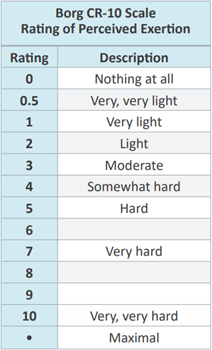
This approach is based on the Borg CR-10 Scale, a standardized method for rating perceived exertion from 0 (no exertion at all) to 10 (extremely strong), or “●” (maximum possible). Each number represents a meaningful change in effort, supported by short verbal descriptions. These descriptions anchor the ratings to improve the reliability of the results.
When to use estimated forces
Estimated forces may be used when measurement tools are not available, cannot be used safely, or are not practical nor feasible. This may include situations where forces are complex (e.g., pushing and turning at the same time) or nonlinear (e.g., rotation). If the actual force is known (such as an object weight or measured push/pull force), use that value as a measured force instead.
How to collect estimated forces
When observing the operator performing a task, keep in mind the following tips:
- Explain to the operator the purpose of the Borg scale and how it works. Define the exertion or task that is being rated.
- The operator should always choose a rating based on the descriptions and should look at the scale immediately after the exertion.
- Give examples for the scale ratings to confirm their understanding. For instance, ask them what the highest exertion they have ever experienced is; that is their “10.” A “0” is the equivalent of sitting or standing quietly without any exertion at all. The numbers also generally correspond to a percentage of their maximum strength, so a “3” for a body force is about 30% of their maximum arm and back strength. Your instructions might go like this:
“We want to rate how strenuous this task feels using an estimated forces scale. We’ll be rating how much you are pushing while operating this cart. The scale uses both ratings and descriptions. For example, 0 means nothing at all while 10 means very, very hard, which is the maximum effort you’ve ever experienced. There is also a dot (●) that represents a very large number greater than 10, which is the absolute maximum effort. Read the descriptions and choose a number that best corresponds with how strenuous you perceive this force to be. Please answer what you feel and not what you think the answer should be.” - Use the same assessor to obtain all ratings from a single operator, ideally the same operator, for both the baseline and follow-up assessments, so that the instructions to the operator and the resulting force estimates remain as consistent as possible.
- Most participants will possess average strength, but for adults who have above or below average strength, modify the Operator Strength Capability during estimated force entry to adjust the overall risk score calculation accordingly, so that the estimated force is on par with the average population.
- If the rating does not match the observed effort (for example, the operator rates a 7 (very hard) for a task that seems to be very easy to do), ask follow-up questions and confirm that the operator understands the scale.
